
Land Acquisition
by Thai national married to a foreigner
A Thai national married to a foreign national may acquire land in Thailand but it must be assured that the land will be a personal property of the Thai spouse and not a joint asset between husband and wife based on marital property laws.
The Thai and foreign spouse must prove to the land official upon ownership registration of the land that the money used for the purchase is personal property of the Thai spouse according to section 1471 and 1472 Civil and Commercial Code and/ or supply an land office official certify letter (copied below) stating that the spending on land is separate property (Sin Suan Tua) or personal asset of the Thai spouse, and not a personal property of the foreign spouse or jointly owned property (sin som ros) between husband and wife. This way it is under Thai Civil law governing 'property of husband and wife' assured that the land is owned and managed by the Thai spouse alone and will not become a jointly owned marital asset with a foreign spouse.
Land ownership registration on Thai spouse's name married to foreigner in Thailand:
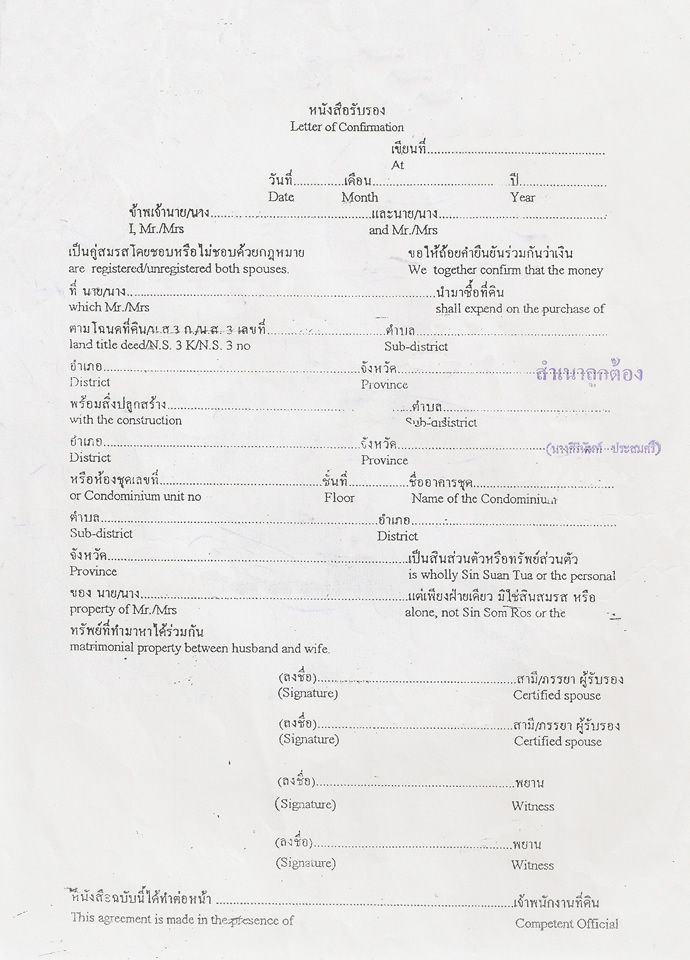
Land Office Confirmation or Certify Letter
The above land office letter of confirmation or certify letter is based on a regulation issued by the Ministry of Interior issued March 23, 1999. Prior to this date a Thai married to a foreigner strictly spoken lost the right to acquire land because such purchase could create joint land ownership between the foreign and Thai spouse (sections 1470 to 1474 civil code) or the Thai could be considered acting as the agent on behalf of the foreign spouse which is both illegal under the land code act.
(source: Ministry of Interior regulation dated March 23 1999)
Acquisition of land by Thais having spouses being foreign
The procedure for the acquisition of land by Thais having spouses being foreign nationals, either by lawful marriage or unlawful marriage (without proper registration like a common-law marriage) and children of foreigners have been changed to be as follows:
- Any Thai having a foreign spouse may purchase or accept land as a gift with no consideration and register the ownership of such land during marriage under the condition that the spouse must jointly provide a written legal confirmation stating that the entire source of funds for such purchase or gift is solely from the Personal Property (such as defined by Thai laws) of such Thai.
- Without written confirmation from a foreign spouse, the request for such registration must be referred to the Land Department in order to obtain an approval from the Minister.
- Any foreigner's minor having Thai nationality may purchase or accept land as a gift with no consideration and register the ownership of such land if it does not appear after investigation that he/she has done so to avoid the law'
For the procedure of the purchase of land by a Thai national married to a foreigner the Thailand Land Department of Thailand issued a further specification on the land acquisition procedure:
Land office procedure, source: Thailand Land Department:
suggestion principle for acquisition of land by a Thai who has a foreign spouse
A Thai, who has an alien spouse (legal or illegal), would like to purchase land, an alien spouse has to confirm in a certify letter that the spending on land is his/her separate property (sin suan tua) or personal asset. The proceeding of certify letters are as follows:
1. In case an alien spouse lives in Thailand:
1.1 In case an alien is a legally spouse, a Thai and an alien spouse have to give joint confirmation in certify letter according to the forms which were specified by the Department of Lands in front of the competent officer in the date of registration of rights and juristic act that the spending on land is sin suan tua (personal property) of a Thai not sin som ros (marital property between husband and wife) of the spouse.
1.2 In case an alien is an illegally spouse, a Thai and an alien spouse have to give joint confirmation in certify letter according to the forms which were specified by the Department of Lands in front of the competent officer in the date of registration of rights and juristic act that the spending on land is personal asset of a Thai only not common property.
2. In case an alien spouse lives in Thailand but could not proceed according to No.1: In case an alien spouse lives in Thailand but in the date of registration an alien could not give written confirmation together with a Thai in front of the competent officer at the registration land office. A Thai and an alien spouse shall lodge the application of testimony form for confirming that the spending on land is sin suan tau or personal asset of only a Thai not sin som ros or common property by lodging the application to the competent officer at provincial land office or any branch land office.
3. In case an alien spouse lives in oversea and could not lodge the application of testimony form according to No.1 and No.2. An alien has to contacts the embassy, consular or notary public for giving testimony of an alien spouse in certify letter according to the forms which were specified by the Department of Lands that the spending on land is sin suan tau or personal asset of a Thai not sin som ros or common property one. The embassy, consular or notary public has to certify that person, who applies for certify letter, is truly spouse or they live together as husband and wife with a Thai. After, a Thai who would like to purchase land shall bring original of certify letter to the competent officer for registration of rights and juristic act accordingly.
4. In case a Thai who has legal or illegal alien spouse, if a Thai could show the evidence indicates that the spending on land is sin suan tau or personal asset according to section 1471 and section 1472 of The Civil and Commercial Code, the competent officer could registers rights and juristic act for a Thai without testimony form of Thai nationality and an alien spouse according No.1 – No.3.
5. In case a Thai, who has alien spouse, purchased land before 23 March B.E. 2542 but informed or submitted a false document declaring that he/she is single. For relaxation of rule to a Thai, who has legal or illegal alien spouse, purchased or owned land after the date of marriage. And a Thai informed or submitted a false document to the competent officer declaring that he/she is single or a Thai has no alien spouse prior to the date of issuing letter of Ministry of Interior, Urgent No. MOI 0710/Circulation 792 dated 23 March B.E. 2542. An alien spouse and a Thai shall together give a written confirmation in certify letter in front of the competent officer that the spending on land is Sin Suan tau or personal asset of only a Thai not sin somros or common property one. After, the competent officer retains documents in dealing file. If an alien spouse who lives oversea and could not give written confirmation together in front of the competent officer, an alien has to contacts the embassy, consular or notary public for giving testimony of an alien spouse in certify letter according to the forms which were specified by the Department of Lands that the spending on land is sin suan tau or personal asset of a Thai not sin som ros or common property one. The embassy, consular or notary public has to certify that person, who applies the certify letter, is truly spouse or they live together as husband and wife with a Thai. After, a Thai who would like to purchase land shall bring original of certify letter to the competent officer for retaining documents in dealing file.
found on samuiforsale
Divorce and land ownership
As a personal property of the Thai spouse, the Thai spouse has sole management of the property, and as a non-marital property the real property is not subject to an equitably division between husband and wife upon termination of marriage.
Possible protection options
When land and house are registered as a personal property of the Thai spouse:
- agree with the Thai spouse on the registration of a right of usufruct over the property in favor of the foreign spouse;
- separate land and house and register the building upon the land as joint or personal property of the foreign spouse (this may not be practical as the land and house have to be transferred separately), or;
- land and house is registered in the Thai spouse's name and the foreign spouse accepts sole management and ownership by his or her Thai spouse.
When undeveloped land is registered as a personal property of the Thai spouse:
- agree on the registration of a right of superficies in favor of the foreign spouse;
- apply for the building permit in the foreign spouse's name (1 and 2 guarantee ownership rights in the structure and use of the land by the foreign spouse);
- the land and building permit is in the Thai spouse's name and the foreigner accepts sole management rights by the Thai spouse.
If possible the foreign spouse must be registered in the house book (tabien baan) of the property, or the couple should obtain a yellow book specifically for foreigners.
Contract termination between spouses
It should be noted that anything done between husband and wife affecting their personal or jointly owned property (any agreements between husband and wife concerning their properties) made after the marriage can legally be reversed or amended during the marriage or within one year of the dissolution of the marriage (section 1469 civil and commercial code).
Any agreements (including gifts) between them concluded during the course of the marriage can simply be voided under Thai law (this includes the gift by a foreign spouse for the purchase of a real property by his or her Thai spouse as a personal non-marital asset in her name, however the return of the property shall be governed by the sections undue or unjust enrichment.
Related:
- house book (tabien baan) in thailand
- property of husband and wife in the civil code of thailand
- Is the house personal property of the Thai spouse? (external)
- What happens to the property upon termination of the marriage (external)
- Official information from the Thailand Land Department (external)