
Leasehold in Thailand
The lease (tenancy) agreement
Lease or rent of land, house or condominium apartment unit for residential purpose by foreigners is governed by civil and commercial code sections 537 to 571. Foreigners are under Thai law allowed to lease real estate property for up to 30 years and the law is applied in the same manner if the lessee is a foreign or Thai national.
Lease term and registration of the lease agreement
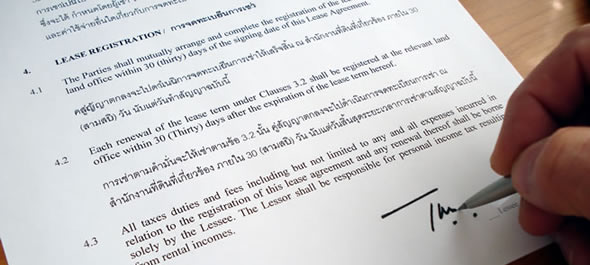
A lease (tenancy rental) agreement exceeding 3 years must be registered with the local land office to be enforceable (by legal action) over 3 years. The lease contract should in any case be registered with the Thailand Land Department within 3 years of signing and beginning of the tenancy or the lessee could lose his right to bring a lease dispute to a court of law. Under the civil and commercial code the maximum lease term in the agreement shall not be over 30 years. Any longer term in the contract to lease shall automatically be reduced back to 30 years (section 540). Also pre-signed or pre-agreed lease renewals are not accepted under Thai law and any agreed consecutive lease terms shall be deemed as part of one lease agreement and reduced to 30 years (section 546). A lease may only be renewed upon expiration of the initial lease agreement term but it must/ cannot exceed thirty years from the time of renewal.
Legal aspects of lease and rental in Thailand
Characteristics of long term tenancies of land and/or house or apartment:
- A written rental agreement or lease agreement is enforceable by legal action (a verbal agreement in general not);
- A rental or lease up to 3 years can be written in another language and does not need to be registered with the land department;
- A rental or lease (leasehold) agreement exceeding 3 years term must have a Thai script version registered with the land department;
- A lease agreement can only be registered over titled property (land with a proper and legally issued title deed)
- A registered leasehold cannot exceed a term of 30 years, the term may be renewed but renewal options are not guaranteed and as personal to the parties to the contract not binding or enforceable by any third parties;
- A lease agreement in essence creates a normal tenancy for the lessee and personal right of use and possession of the property (e.g. he can only sub-lease if this is agreed in the lease agreement and he can only assign his leasehold interest to another person with permission and cooperation of the owner);
- A property lease is under Thai lease (rental/ tenancy) laws automatically terminated upon death of the lessee, but not upon death of the owner (section 569);
- A lease registration fee (for registered leases exceeding 3 years) shall be collected at the rate of 1% of the total rental throughout the lease term and stamp duty shall be collected at the rate of 0.1%, also over the total rental throughout the lease term;
- A sublease, rental or lease income is subject to personal income tax.
The property (land) lease by foreigners
In a 'leasehold' purchase by a foreigner in Thailand the most complicated part of the transaction is the drafting of the terms and conditions and structuring the lease agreement structure in a way that it offers the best protection for the foreign leaseholder. The lease agreement must be drafted by an experienced property legal professional to include the necessary protection for the lessee or the lease may not be enforceable throughout the term (e.g. terminated upon death of the lessee). There are various ways to draft a lease or leasehold agreement in Thailand, but generally the lease agreement must be written in Thai and comply with the civil code and land office guidelines. The lease with a foreigner must under these guidelines be will be examined by the Land Office official before registration, the lease can for example not include the right to transfer to freehold or prepaid additional lease terms in a renewal option.
Lease registration at the Land Office
The lease agreement will be noted on the backside of the ownership title deed of the owner and on the original title deed as held by the Land Office. There will also be an official Thai language one page lease document with the government’s Guaruda symbol (see sample) that parties need to sign at the Land Office. This official document must refer to the private lease agreement between the parties. A copy of the private lease agreement together with the official land office lease document will be annexed to the land title deed held by the Land Office.
The lease registration fees including stamp duty are 1.1 % over the total lease price for the entire 30 year term. This should also be paid upon registration of the lease agreement. Income (rental) from the lease agreement is taxed as personal income of the owner and must be paid to the Revenue Department.
At the Land Office everything is done in Thai, even your name is usually written in Thai script. It is common that foreigners use a Thai national (Thai lawyer) who can act on their behalf at the Land Office under a land office form power of attorney (in Thai script and with the Thai government’s Garuda symbol on it). This is the only form of power of attorney accepted by the Land Department.
Common mistakes:
As with buying property the land (property) to be leased should have an unencumbered and legal title deed and not for example concern mere possessory land rights or land under mortgage or property transferred under a right of redemption by the previous owner as this could affect the validity of the lease agreement and enforceability. A misunderstanding of lease or tenancy laws and how to structure a long term land (apartment) lease in Thailand often leads to the following errors:
- Expecting that everything that is written in the lease agreement is enforceable because the Land Office registered the lease (except for some specific void clauses the Land Office does not determine the validity and enforceability of the terms and conditions in the private lease agreement);
- The lease agreement exceeding 3 years is not registered with the Land Department (therefore not enforceable by legal action for the period exceeding 3 years);
- The standard short form land office lease document is registered without annexing the private lease agreement between the parties;
- The long term lease concerns land and house where land and house could be separated (land lease and ownership of the building) leading to a stronger position of the lessee and preventing the yearly housing and land tax;
- The land does not have a proper title deed or is not suitable (or restricted) for building or has other legal problems or restrictions (this can be prevented by conducting due diligence prior to entering into a lease agreement (sample checklist);
- The lease agreement is poorly drafted and will end at death of the lessee, irrespective the term in the lease agreement.
- The lease agreement is entered between spouses (e.g. a foreign and Thai spouse) without considering marital property laws which supersede such agreements entered into during marriage (it creates a voidable lease agreement).
Most problems can be prevented by proper planning, due diligence on the property and obtaining legal advice and assistance prior to signing any lease agreement or paying a tenancy contract deposit.
Land lease agreement including the structure (house)
In a long term leasehold interest in a real property by foreigners in Thailand the lease could be structured with ownership over the structures upon the land. It’s only the land part under the Land Code Act which is restricted for foreign ownership and not the building on lease land. The preferred legal structure in Thailand to obtain a long term interest in a property is a land lease with all options combined with a right of superficies or a separate sale of the building procedure (registered with the Thailand Land Department).
Housing and land tax
Thailand charges Building and Land Tax at the rate of 12.5% of the yearly rental according to the property lease agreement or the annual value assessed by the Land Department, whichever is higher over property that is not the primary residence of the owner (e.g. a second home or a property that is rented out by the owner). In case of a property (land AND house) owned by a company building and land tax must be paid by the company irrespective if rent is paid or income is received by the company from it.
Lease purchase in a residential housing development
In an official (licensed) property development the content of the freehold sale contracts under which the property is sold must comply with strict land rules and housing development and consumer protection laws. Selling land and house in the same development under a leasehold contract to foreigners does not have to comply with the same laws and the developer can, based on general freedom of contract, include various for him beneficial clauses misleading clauses in the lease agreement to generate sales, such as additional lease renewal terms suggesting a 90-year lease term, but which is under Thai tenancy laws enforceable by legal action as a 30-year term lease only.
Specific rent and lease of commercial property
Commercial rentals are like residential rentals governed by the civil and commercial code. Only to stimulate foreign investment the Thai government created a specific act, the 'The Hire of Immovable Property for Commerce and Industry by Aliens Act B.E. 2542'. This act only applies when the conditions under this act are met (a considerable investment and remittance into Thailand), if not, hire of immovable property for commerce and industry by foreigners is governed by the section 'Hire of Property' in the civil and commercial Code.
Related:
- ownership of a house separate from the land
- housing an land tax
- translation lease laws in Thailand
- hire of property for commerce and industry by foreigners
- dowload a 30 land lease with all options
- download a residential real estate tenancy agreement